

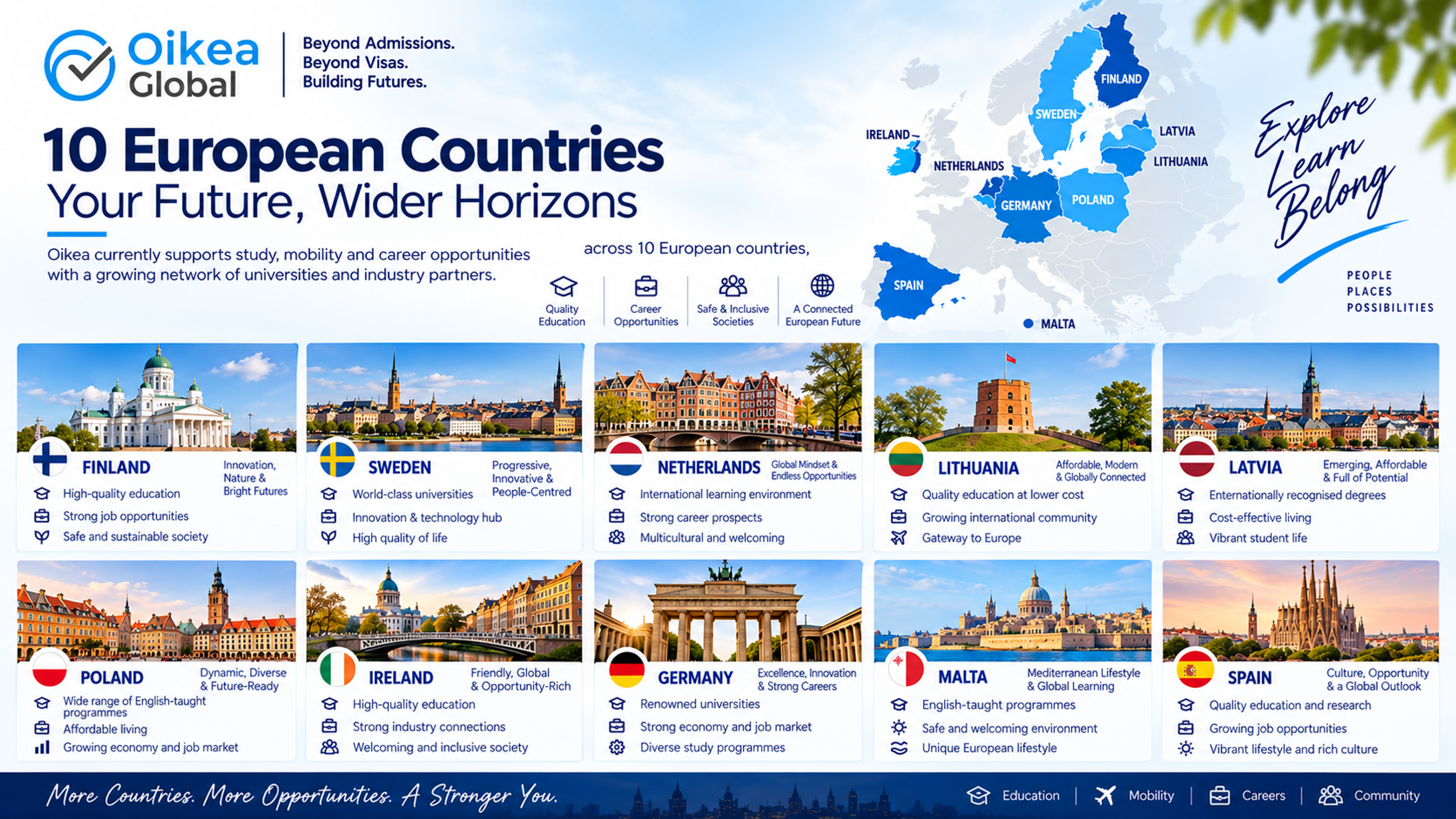
Choosing where to study, work, settle or build a career in Europe is more than choosing a university. The country itself shapes the experience: its language, population, economy, culture, food, climate, social environment, currency and relationship with the wider European mobility system.
Oikea currently supports opportunities across ten European countries: Finland, Sweden, the Netherlands, Lithuania, Latvia, Poland, Ireland, Germany, Malta and Spain.
They are all EU member states, but they are not the same. Some are Nordic. Some are Baltic. Some are large industrial economies. Others are smaller, highly international or English-friendly environments. Some use the euro; Sweden and Poland do not. Ireland is in the EU but is outside the Schengen Area.
This guide is designed to help you compare the countries before you compare universities.
The 10 countries at a glance
| Country | Population (2025) | Area | Official EU language(s) | EU | Schengen | Currency | Region |
|---|---|---|---|---|---|---|---|
| Finland | 5.64m | 338,363 km² | Finnish, Swedish | Yes | Yes | Euro | Nordic |
| Sweden | 10.59m | 447,424 km² | Swedish | Yes | Yes | SEK | Nordic |
| Netherlands | 18.04m | 37,391 km² | Dutch | Yes | Yes | Euro | Western Europe |
| Lithuania | 2.89m | 65,284 km² | Lithuanian | Yes | Yes | Euro | Baltic |
| Latvia | 1.86m | 64,594 km² | Latvian | Yes | Yes | Euro | Baltic |
| Poland | 36.50m | 311,928 km² | Polish | Yes | Yes | PLN | Central Europe |
| Ireland | 5.44m | 69,947 km² | Irish, English | Yes | No | Euro | Western Europe |
| Germany | 83.58m | 357,569 km² | German | Yes | Yes | Euro | Central Europe |
| Malta | 0.57m | 316 km² | Maltese, English | Yes | Yes | Euro | Mediterranean |
| Spain | 49.08m | 505,983 km² | Spanish* | Yes | Yes | Euro | Southern Europe |
*Spain also has co-official regional languages in several autonomous communities.
Population and area figures use 2025 figures published in the European Union country profiles, sourced to Eurostat.
Compare before you choose
- Population gives a sense of the scale of the domestic market and society.
- Area and population density help explain why Finland and Sweden feel very different from Malta or the
Netherlands. - Language matters for daily life, integration and long-term career planning.
- EU and Schengen are related but are not the same thing.
- Currency matters when comparing tuition, living costs, wages and financial planning.
Country-by-country comparison
Finland
Country DNA: Nordic • EU • Schengen • Euro
| Population | 5,635,971 (2025) |
| Area | 338,363 km² |
| Official EU languages | Finnish, Swedish |
| Currency | Euro (€) |
| EU / Schengen | EU member / Schengen member |
Culture & everyday identity: Nature, equality, personal space, design, education, sauna culture and the idea of *sisu* are strongly associated with Finnish identity.
Food identity: Rye bread, fish, potatoes, berries, mushrooms and seasonal Nordic ingredients.
Key economic strengths: Technology, engineering, clean technology, forestry and bioeconomy, energy, healthcare and digital industries.
Distinctive feature: A very large country by European standards with a relatively small population and extensive natural areas.
Worth exploring if you value: Technology, engineering, sustainability, Nordic society, nature and innovation.
Sweden
Country DNA: Nordic • EU • Schengen • Swedish krona
| Population | 10,587,710 (2025) |
| Area | 447,424 km² |
| Official EU language | Swedish |
| Currency | Swedish krona (SEK) |
| EU / Schengen | EU member / Schengen member |
Culture & everyday identity: Innovation, equality, design, outdoor life and the everyday tradition of *fika* are strongly associated with Sweden.
Food identity: Fish, potatoes, crispbread, dairy, meatballs and cinnamon buns.
Key economic strengths: Technology, telecommunications, engineering, automotive, life sciences, green industry, design and advanced manufacturing.
Distinctive feature: A geographically large Nordic country with a strong international innovation profile.
Worth exploring if you value: Technology, engineering, sustainability, creative industries, research and international business.
Netherlands
Country DNA: Western Europe • EU • Schengen • Euro
| Population | 18,044,027 (2025) |
| Area | 37,391 km² |
| Official EU language | Dutch |
| Currency | Euro (€) |
| EU / Schengen | EU member / Schengen member |
Culture & everyday identity: Cycling, water management, practical planning, direct communication and an international outlook are distinctive features.
Food identity: Cheese, bread, herring, pancakes and stroopwafels.
Key economic strengths: International trade, logistics, agriculture and food technology, technology, finance, chemicals and life sciences.
Distinctive feature: A relatively small country with a large population and major European trade and logistics importance.
Worth exploring if you value: International business, logistics, technology, entrepreneurship and international environments.
Lithuania
Country DNA: Baltic • EU • Schengen • Euro
| Population | 2,890,664 (2025) |
| Area | 65,284 km² |
| Official EU language | Lithuanian |
| Currency | Euro (€) |
| EU / Schengen | EU member / Schengen member |
Culture & everyday identity: Strong Baltic historical identity combined with modern, increasingly digital urban culture.
Food identity: Potatoes, rye bread, dairy products, soups and traditional dishes such as cepelinai.
Key economic strengths: Fintech, ICT, manufacturing, logistics, shared services and life sciences.
Distinctive feature: A Baltic country with a growing profile in digital business and fintech.
Worth exploring if you value: Digital business, fintech, technology, emerging European markets and Baltic culture.
Latvia
Country DNA: Baltic • EU • Schengen • Euro
| Population | 1,856,932 (2025) |
| Area | 64,594 km² |
| Official EU language | Latvian |
| Currency | Euro (€) |
| EU / Schengen | EU member / Schengen member |
Culture & everyday identity: Baltic heritage, forests, music, architecture and strong national identity; Riga is the main international centre.
Food identity: Rye bread, fish, potatoes, dairy products and seasonal foods.
Key economic strengths: Logistics, transport, ICT, timber and wood products, manufacturing and services.
Distinctive feature: A small Baltic market with a strategic geographical position between Northern and Eastern Europe.
Worth exploring if you value: Baltic Europe, logistics, digital services, smaller-market environments and regional mobility.
Poland
Country DNA: Central Europe • EU • Schengen • Polish złoty
| Population | 36,497,495 (2025) |
| Area | 311,928 km² |
| Official EU language | Polish |
| Currency | Polish złoty (PLN) |
| EU / Schengen | EU member / Schengen member |
Culture & everyday identity: Strong historical identity, regional traditions, family culture, literature, music and local customs.
Food identity: Pierogi, soups, rye bread, sausages and regional dishes.
Key economic strengths: Manufacturing, automotive, IT, business services, logistics, finance and engineering.
Distinctive feature: One of the largest populations and markets in Oikea's ten-country network.
Worth exploring if you value: Engineering, manufacturing, IT, business services, logistics and a large European market.
Ireland
Country DNA: Western Europe • EU • Non-Schengen • Euro • English-speaking
| Population | 5,439,898 (2025) |
| Area | 69,947 km² |
| Official EU language | Irish, English |
| Currency | Euro (€) |
| EU / Schengen | EU member / not part of Schengen |
Culture & everyday identity: Music, literature, storytelling, sport, community traditions and a distinctive national identity.
Food identity: Irish stew, soda bread, seafood, potatoes and dairy.
Key economic strengths: Technology, pharmaceuticals, medical technology, financial services and international business.
Distinctive feature: An English-speaking EU country that is outside the Schengen Area.
Worth exploring if you value: English-language environment, technology, pharmaceuticals, medtech, international business and an EU setting.
Germany
Country DNA: Central Europe • EU • Schengen • Euro
| Population | 83,577,140 (2025) |
| Area | 357,569 km² |
| Official EU language | German |
| Currency | Euro (€) |
| EU / Schengen | EU member / Schengen member |
Culture & everyday identity: Strong regional identities, engineering, music, crafts and manufacturing, with significant differences between regions and cities.
Food identity: Bread, sausages, potatoes and diverse regional cuisines.
Key economic strengths: Automotive, mechanical engineering, manufacturing, chemicals, pharmaceuticals, technology and logistics.
Distinctive feature: The largest population among Oikea's ten countries and one of Europe's major industrial centres.
Worth exploring if you value: Engineering, automotive, manufacturing, research, technology and a large employment ecosystem.
Malta
Country DNA: Mediterranean • EU • Schengen • Euro • Maltese & English
| Population | 574,250 (2025) |
| Area | 316 km² |
| Official EU languages | Maltese, English |
| Currency | Euro (€) |
| EU / Schengen | EU member / Schengen member |
Culture & everyday identity: Mediterranean traditions combined with strong historical links to Britain, Italy and wider Europe; English is important in public and professional life.
Food identity: Mediterranean ingredients, seafood, *pastizzi*, rabbit dishes and Italian-influenced foods.
Key economic strengths: Tourism, financial services, digital services, gaming and international business.
Distinctive feature: By far the smallest country in Oikea's current network at only 316 km².
Worth exploring if you value: English, Mediterranean lifestyle, tourism, international services and digital industries.
Spain
Country DNA: Southern Europe • EU • Schengen • Euro
| Population | 49,077,984 (2025) |
| Area | 505,983 km² |
| Official EU language | Spanish; regional co-official languages in several autonomous communities |
| Currency | Euro (€) |
| EU / Schengen | EU member / Schengen member |
Culture & everyday identity: Strong regional identities, festivals, music, sport, architecture, family traditions and distinct local cultures.
Food identity: Tapas, paella, seafood, olive oil, cured meats and highly regional cuisines.
Key economic strengths: Tourism, automotive, renewable energy, manufacturing, agriculture and food, services and technology.
Distinctive feature: The largest country by area in Oikea's current ten-country network.
Worth exploring if you value: Lifestyle, tourism, renewable energy, international business, regional diversity and a large European market.
The comparisons that matter most
| Priority | Countries to explore | Comparison point |
|---|---|---|
| Nordic environment | Finland • Sweden | Both are Nordic, EU and Schengen countries. Finland uses the euro; Sweden uses the Swedish krona. |
| English-language environment | Ireland • Malta | Both have English as an official EU language. Ireland is outside Schengen; Malta is in Schengen. |
| Large industrial ecosystem | Germany • Poland | Both have large domestic markets and strong manufacturing, engineering and business-service ecosystems. |
| Technology & innovation | Finland • Sweden • Netherlands • Ireland | All have strong profiles in technology, innovation and internationally connected businesses. |
| Baltic environment | Lithuania • Latvia | Both are Baltic, EU, Schengen and euro-area countries. |
| Trade & logistics | Netherlands • Germany • Poland | All have major roles in European trade, logistics and industrial supply chains. |
| Mediterranean lifestyle | Malta • Spain | Both are Mediterranean, but their scale is dramatically different. |
| Euro currency | Finland • Netherlands • Lithuania • Latvia • Ireland • Germany • Malta • Spain | Eight of the ten Oikea countries use the euro. Sweden and Poland do not. |
| Schengen | All except Ireland | Nine of the ten countries are currently in the Schengen Area. |
Europe, EU, Schengen and Nordic are not the same
Europe is a geographical and cultural region. The European Union is a political and economic union of 27 member states. The Schengen Area is a separate border-free travel area.
The Schengen Area currently includes 29 countries: 25 EU member states plus Iceland, Liechtenstein, Norway and Switzerland. Ireland is not part of Schengen.
The Nordic countries are Finland, Sweden, Denmark, Norway and Iceland. In Oikea's current ten-country network, Finland and Sweden are the Nordic destinations.
A country being in the EU does not automatically mean it uses the euro, and being in Europe does not automatically mean being in the EU or Schengen.
Culture matters
A successful international education journey is not only an academic decision. Students spend years living in a society. Language, food, climate, social norms, religious heritage, family culture, communication style and everyday lifestyle can all affect comfort, integration and the ability to build a social and professional network.
The cultural notes in this guide are broad orientation points, not stereotypes. Every country contains regional, generational, religious and individual differences.
How should you choose?
Education fit: Does the country offer the right programme, teaching approach and academic progression for your field?
Financial fit: Can you realistically manage tuition, accommodation, living costs, insurance and travel?
Language fit: Is the programme taught in English? What language will matter outside the classroom?
Career fit: Which industries and employers are strong in the country and relevant to your field?
Cultural fit: Would the climate, food, social culture and everyday environment suit you?
Family fit: If family migration is relevant, what does the country's system mean for your circumstances?
Mobility fit: How does the country's EU and Schengen position affect your intended travel and mobility?
Long-term fit: What realistic pathways exist after graduation for further study, work or other lawful residence routes?
The Oikea approach
At Oikea, we believe the right destination is not necessarily the most popular destination. It is the destination that creates the strongest fit between a person's aspirations and the opportunities available.
Education → Mobility → Settlement → Career → Opportunity
That is why country selection should come before programme selection — and programme selection should be connected to a longer-term career and mobility plan.
Your next step
Use this guide as a starting point. Shortlist two or three countries, then compare the actual programmes, tuition, scholarships, admission requirements, accommodation, residence rules, employment environment and career opportunities relevant to your profile.
Oikea can then help you move from a broad country choice to a more specific education and mobility pathway.
Explore Country Guides • Explore Study Opportunities • Talk to Oikea
Editorial information & sources
Information reviewed: September 2026.
Population, area, official EU language, currency, EU membership and Schengen status are based on official European Union country profiles, with population and area figures sourced to Eurostat. Schengen-wide information is based on the Council of the European Union.
Economic, cultural and food descriptions are concise orientation notes. They are not rankings and do not attempt to describe every regional or social difference.
● European Union – EU country profiles: https://european-union.europa.eu/principles-countries-history/eu-countries_en
● European Commission – Study in Europe: https://education.ec.europa.eu/education-levels/higher-education/study-in-europe
● Council of the EU – The Schengen area explained: https://www.consilium.europa.eu/en/policies/schengen-area/
● Council of the EU – EU visa policy: https://www.consilium.europa.eu/en/policies/eu-visa-policy/
● Eurostat – Demography of Europe 2026: https://ec.europa.eu/eurostat/web/interactive-publications/demography-2026
Important: Country, programme, tuition, visa, residence and employment rules can change. Before making a decision, always verify current requirements with the relevant university and official government or immigration authority.